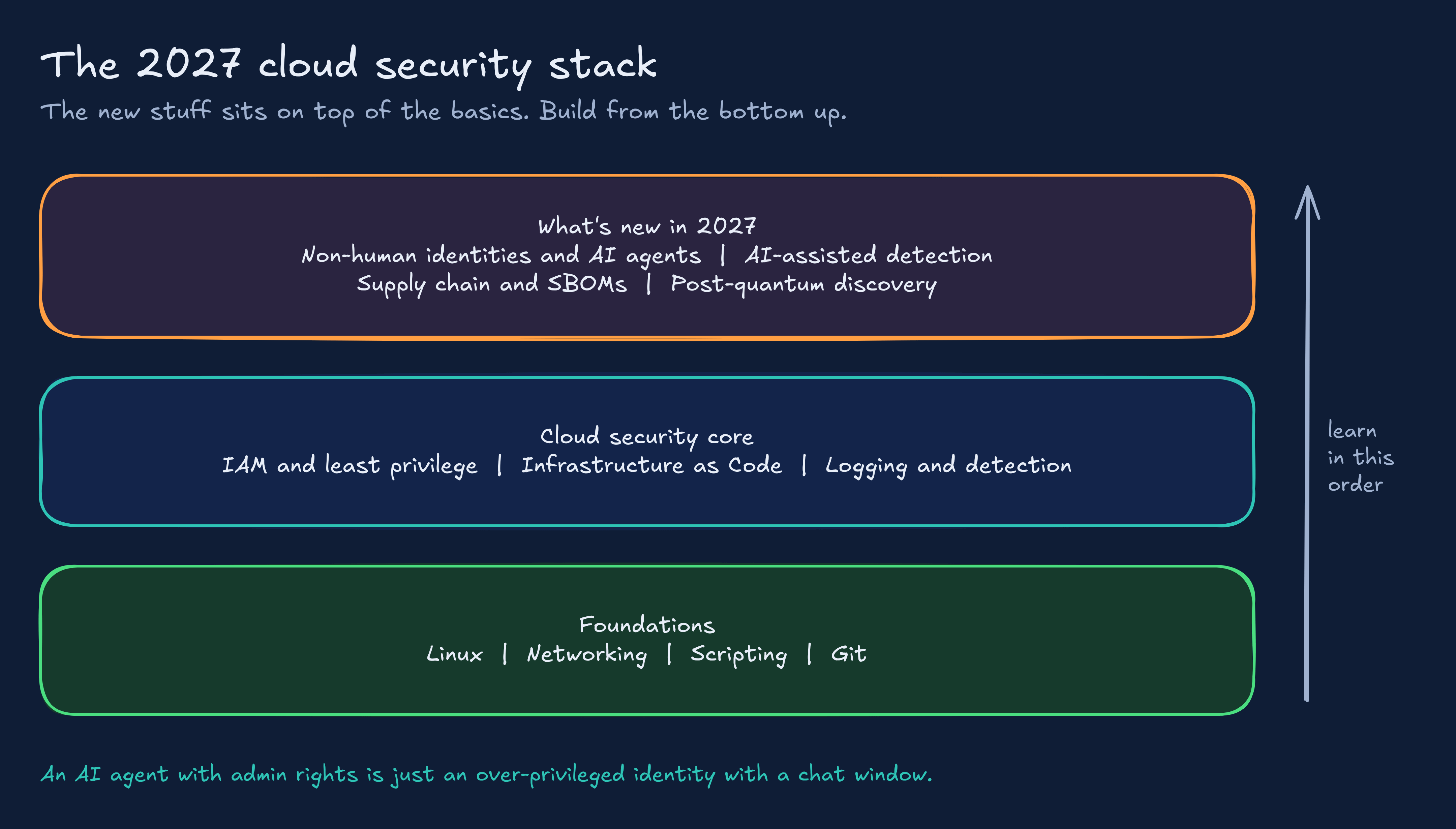
Tbh with how rapid AI is moving right now nobody really knows what the next year is going to look like, however, as a random guy that yaps for a living here’s what I think Cloud Security is all about in 2027
I want to take the time to walk through my thinking for entry level positions later on and expanding upon this
1. Identities in your cloud won’t be people
I’ve spent years saying “identity is the new perimeter”. That’s still true. What’s changed is whose identity. Service accounts, access keys, CI/CD pipelines, and now AI agents all log in to your cloud. These are called “non human identities.”
Okay, but why does that matter? Because attackers have noticed. A September 2026 piece on Okta’s blog describes the pattern: steal a person’s login, use it to reach a service account with more power, then jump to an AI agent or automation with even more access. It also predicts non human identities will outnumber human ones in many companies before the end of 2027.
My take: in 2027, “who has access to what?” gets a lot harder to answer, and the people who can answer it will be in demand. If you’ve learnt IAM properly, you’re already ahead.
2. AI agents become a normal thing to secure
A year ago, AI security felt like a niche. Now every company is plugging agents into their tickets, their code, their cloud consoles.
An agent is basically a new kind of employee that reads untrusted text all day and has the keys to your systems. You can see the problem. Prompt injection, over-powered tools, and agents talking to other agents (often through MCP) are going to show up in normal security reviews, the same way “is this S3 bucket public?” does today.
3. Attackers get faster, so defenders have to as well
In November 2025, Anthropic published a report on what it called the first reported AI-orchestrated cyber espionage campaign. A state backed group used an AI coding agent against around 30 targets, and Anthropic says the AI did 80 to 90% of the work, with humans stepping in at only a handful of decision points.
Defenders get the same tools. The same report says Anthropic’s own threat team used AI to analyse the investigation data. I think 2027 is the year “I use AI to triage alerts and review IaC” stops being a party trick and becomes an expected skill. Not instead of knowing the fundamentals.
4. Regulation lands on the engineering team
Since 11 September 2026, the EU Cyber Resilience Act has required makers of products with digital elements sold in the EU to report actively exploited vulnerabilities and severe incidents, with an early warning within 24 hours. The rest of the act applies from 11 December 2027.
Why should a cloud security beginner care? Because someone has to know what software is in the product, find the vulnerable bits, and prove it was fixed. That’s SBOMs, dependency scanning and good logging. Remember the OSV-Scanner post?
5. Post quantum??
Quantum computers that can break today’s encryption aren’t here yet. The UK’s NCSC wants organisations to have mapped where they use cryptography and drafted a migration plan by 2028, with everything migrated by 2035.
You don’t need to understand the maths. You do need to know where your certificates, keys and TLS settings live in the cloud, because 2027 is when a lot of teams start that discovery work. Another win for people who know their KMS from their ACM.
What won’t change
For all the talk of agents and quantum, most cloud breaches in 2027 will still come from the boring stuff. A storage bucket left open. A key committed to GitHub. A role with far too many permissions.
The flashy new risks sit on top of the old ones. An AI agent with admin rights is just an over privileged identity with a chat window. A post quantum migration is just asset inventory with harder maths. Supply chain regulation is just knowing what’s in your software.
So the fundamentals don’t go out of date. If anything they matter more, because everything new is built on them:
Linux and networking: still how everything talks to everything.
IAM and least privilege: now covering people, pipelines and agents.
Infrastructure as Code: if it’s not in code, you can’t review it or scan it.
Logging and detection: you can’t respond to what you can’t see.
I’m a firm believer that the people who do well in 2027 won’t be the ones chasing every new acronym. They’ll be the ones with solid basics who can learn the new stuff quickly.
So what does this mean if you’re breaking in?
Okay, but where does that leave you if you’re just starting out?
In a pretty good spot, actually. Here’s how I’d think about it.
Build from the bottom up. Don’t skip to AI agent security because it’s trendy. Linux, networking, IAM and IaC first. Everything above sits on them.
Then pick one new thing and go deep. You don’t need all five shifts. Pick the one that excites you. Agents? Break AIGoat. Supply chain? Run OSV-Scanner on your own projects. Identity? Go and audit every role and access key in your practice account with Prowler.
Show your work. In 2027 more people will claim AI security skills than will actually have them.
Learn to work with AI, not hide from it. Use it to explain a policy you don’t understand, review your Terraform, or summarise a long log file. Then check what it tells you. The skill isn’t using AI. It’s knowing when it’s wrong.
And one last thing. The industry will keep changing. It always has. The people who do well are the ones who stay curious and keep building. That’s you, if you’re reading this. 😉
Hit reply and tell me your one prediction for 2027. I read every one.
Thank you for reading: Keep it secure, keep it light hearted!
W J Pearce - Cyber Notes
Calm, practical & self paced training to help you break into Cloud Security & DevSecOps
👉 Pre-order here: techtwoforty.com