



Last Issue: Cyber Notes is Changing…
Next Issue: Hacking Project 101: Reverse Shells with Netcat
This Issue: AWS Project: Security Token Service 🔑
I recently did a collab with Abed Hamdanm or as you might know him…UnixGuy!
Each challenge presents a key question, a common misconception (the wrong answer), and the correct, detailed explanation. Test yourself and see how well you know the fundamentals!
Skip to 29:00 for my section on 5 x Common Entry Level Cloud Security Interview Questions
Question #1: Role-Based Access Control (RBAC)
Question: “What is role-based access control and how is it implemented in a cloud platform?”
❌ Wrong Answer (Misconception): “RBAC means each user has their own custom role with specific permissions. That’s incorrect because RBAC is about shared, standardised roles based on job functions, not user customisation, and direct user permissions don’t scale well.”
✅ Correct Answer: “RBAC is a security model where permissions are assigned to roles rather than individual users, and users are then added to those roles based on their job function. In cloud platforms like AWS IAM, RBAC is implemented by creating roles such as developer, security auditor, or database administrator, assigning specific permissions to each, and then attaching users or service accounts to those roles.”
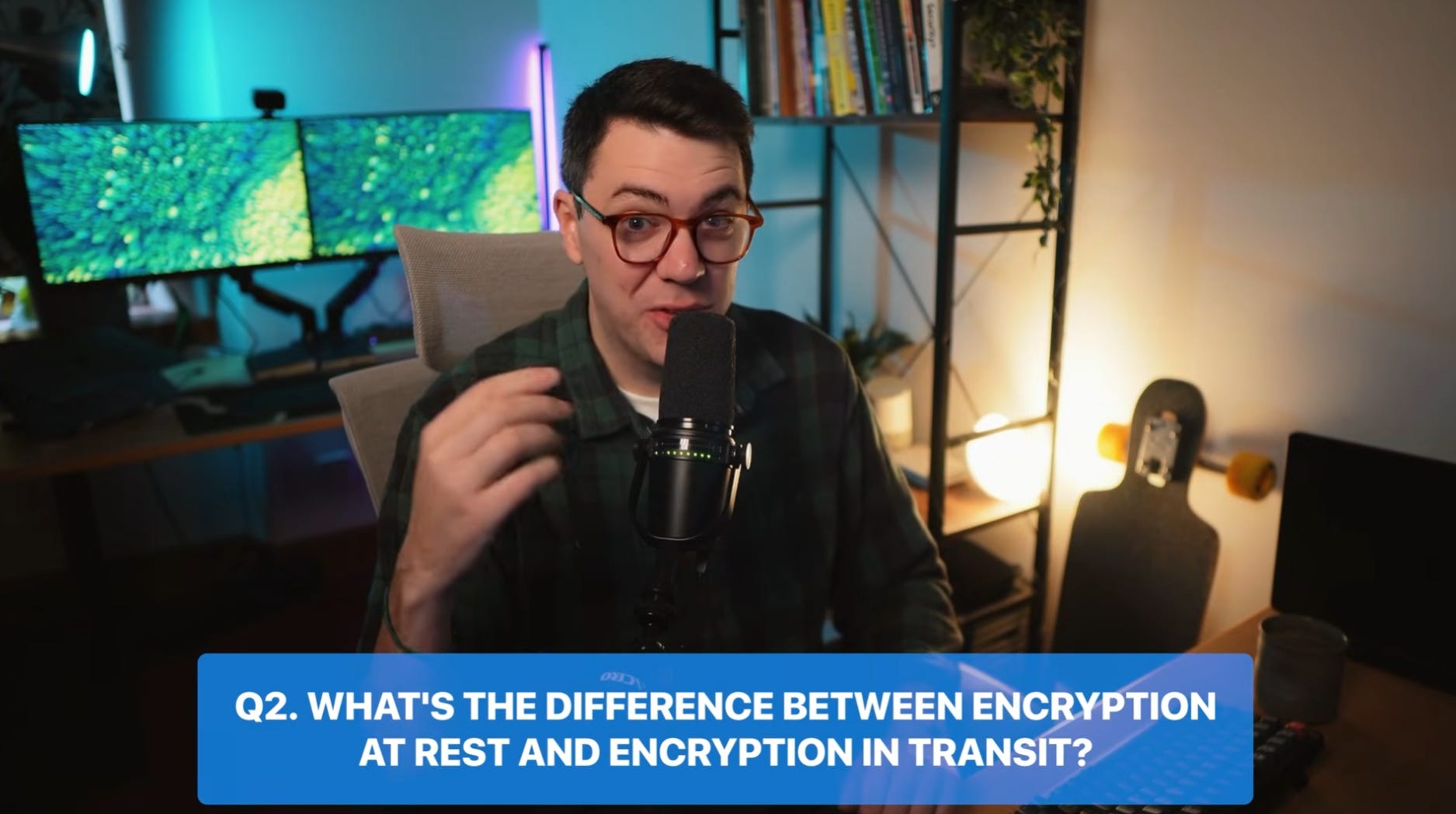
Question #2: Encryption
Question: “What’s the difference between Encryption at Rest and Encryption in Transit?”
❌ Wrong Answer (Misconception): “Encryption in transit is only needed for public internet traffic and not internal cloud traffic. That’s wrong because even traffic inside a cloud environment should be encrypted to prevent interception by attackers.”
✅ Correct Answer: “Encryption at rest protects data while it’s stored on a disk or in a database so that if someone gains access to the storage, they can’t read the data without encryption keys. Encryption in transit protects data while it’s moving between two points, such as from a user’s browser to a server or between two cloud services, preventing eavesdropping during transmission.”
Question #3: Security Groups
Question: “What is a Security Group (or Network Security Group), and how does it work in the cloud?”
❌ Wrong Answer (Misconception): “A security group encrypts traffic that passes through it. That’s wrong because security groups only control whether traffic is allowed or denied; they do not encrypt, decrypt, or inspect the contents of the traffic.”
✅ Correct Answer: “A security group is a virtual firewall that controls inbound and outbound traffic to cloud resources such as virtual machines or containers. It works by defining rules that specify which traffic is allowed based on protocol, port, and source or destination IP addresses. Security groups are stateful, meaning if inbound traffic is allowed, the return traffic is automatically allowed without needing a separate outbound rule.”
Question #4: Infrastructure as Code (IaC)
Question: “What is Infrastructure as Code (IaC) and what are the security benefits?”
❌ Wrong Answer (Misconception): “IaC is mainly for automation and faster deployment; it doesn’t improve security.”
✅ Correct Answer: “Infrastructure as Code (IaC) is the practice of managing and provisioning infrastructure through code instead of manual setup. It improves security by ensuring consistency across environments, minimising human error, enabling version control to track and review changes, and supporting automated security scanning to detect misconfigurations before deployment.”
Question #5: Secrets Management
Question: “What is the purpose of Secrets Management in a cloud-based environment?”
❌ Wrong Answer (Misconception): “Secrets management is just about encrypting passwords in a database.”
✅ Correct Answer: “Secrets management is the practice of securely storing, accessing, and managing sensitive information such as passwords, API keys, database credentials, and tokens. Its purpose is to prevent secrets from being hardcoded into application code or configuration files and instead store them in a centralised, secure location that allows automatic rotation of credentials.”
WJPearce - Cyber Notes
Enjoyed this? Why not check out my other reads…
“Secrets management is the practice of securely storing, accessing, and managing sensitive information such as passwords, API keys, database credentials, and tokens. Its purpose is to prevent secrets from being hardcoded into application code or configuration files and instead store them in a centralised, secure location that allows automatic rotation of credentials.”
Clean definition. Nice read and a good selection of questions, thanks.